 Bethlehem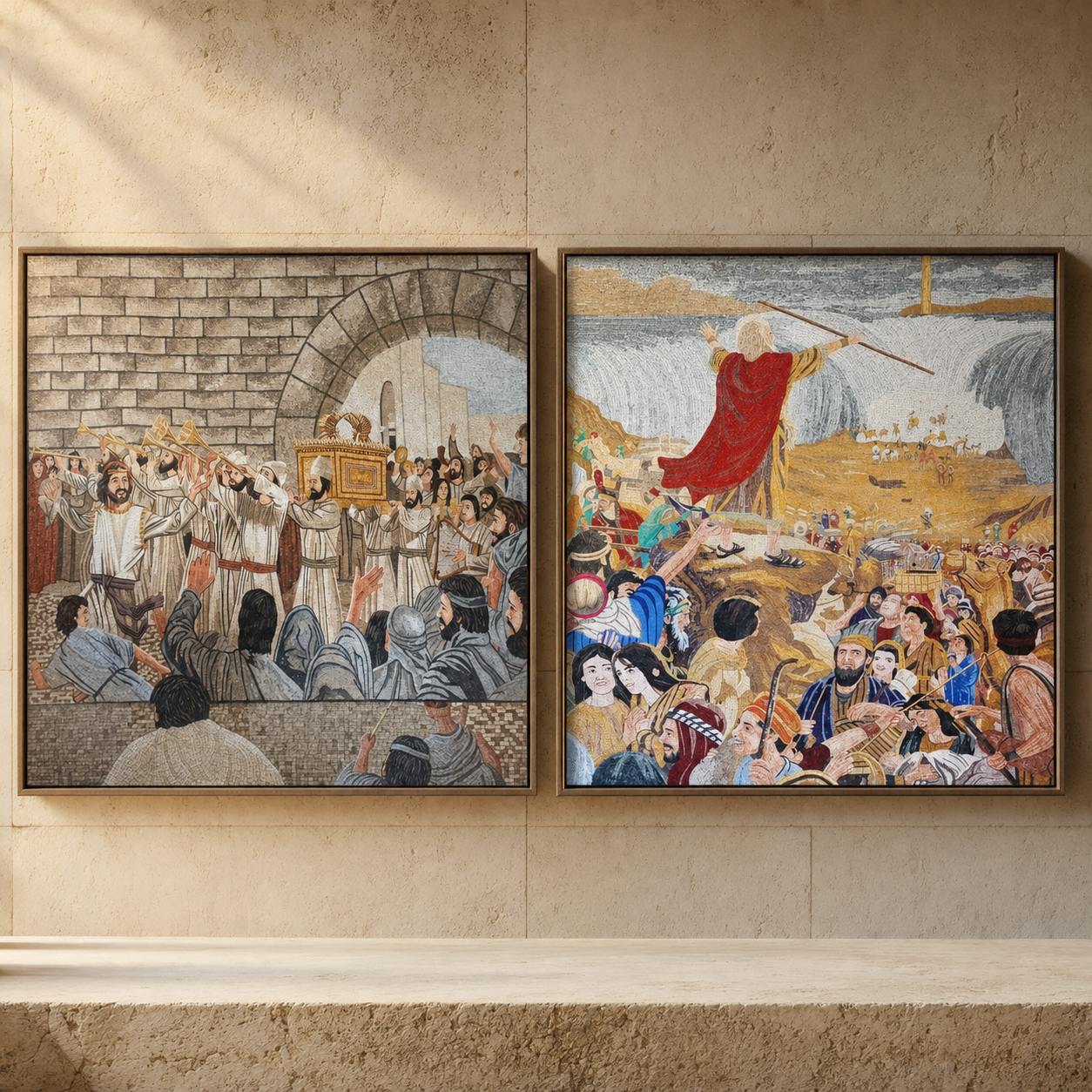
Long before mosaic art became closely associated with New Testament imagery, visual storytelling around Old Testament scenes and figures held its own important place in religious art. Moses, the Ark of the Covenant, the crossing of the Red Sea, and other pivotal Old Testament moments continue to inspire mosaic artists today, offering rich, dramatic subject matter for handmade stone artwork.
Visual Storytelling Rooted in Shared Scripture
Old Testament scenes hold significance for both Jewish and Christian traditions, and mosaic artists approaching these subjects generally aim for respectful, recognizable visual storytelling rather than a specific doctrinal interpretation. A mosaic depicting Moses or the Ark of the Covenant should be understood as an artistic interpretation of a shared scriptural narrative, not as a literal historical reconstruction or an archaeological claim about any specific event or object.
Creation Themes in Mosaic Form
Creation is among the most ambitious subjects an artisan can attempt, since it invites a sweeping composition, land, sea, sky, and living creatures, all rendered through small, individually placed stone tesserae. Mosaics on this theme often emphasize a sense of order emerging from raw material, an idea that mirrors, in a way, the mosaic-making process itself: a complete world built patiently from many small individual pieces.
Moses and the Exodus
The story of Moses and the Exodus offers some of the most visually dramatic material in the Old Testament, from the parting of the Red Sea to the long journey through the wilderness. Mosaic depictions of these events typically focus on a single dramatic moment rather than attempting to narrate the entire story, allowing the artwork to communicate a clear, powerful image at a glance.
The Ark of the Covenant
The Ark of the Covenant, described in scripture as a sacred and closely guarded object, appears in mosaic art as a symbol of covenant, presence, and reverence. Artistic depictions of the Ark are, necessarily, interpretations rather than historical reconstructions, since no verified physical description or surviving example exists to copy directly. Mosaic artists working with this subject aim to evoke its significance rather than claim precise historical accuracy.
Prophets and Covenant Themes
Beyond specific narrative scenes, mosaic art connected to the Old Testament often draws on broader covenant themes: promises kept across generations, guidance offered through difficult times, and the relationship between a people and their faith. These themes can be expressed through symbolic imagery as much as through literal narrative scenes, giving artisans flexibility in how directly or abstractly they choose to represent a given subject.
Displaying Old Testament Mosaic Art
Old Testament mosaics work well in settings that invite reflection on faith history and shared scripture: a study, a church classroom or hallway, or a living room shared by a family that values biblical education alongside devotional art. Because scenes like Creation or the Exodus often carry a sense of scale and drama, larger compositions can serve as a striking centerpiece, while smaller, more symbolic pieces suit quieter, more personal spaces.
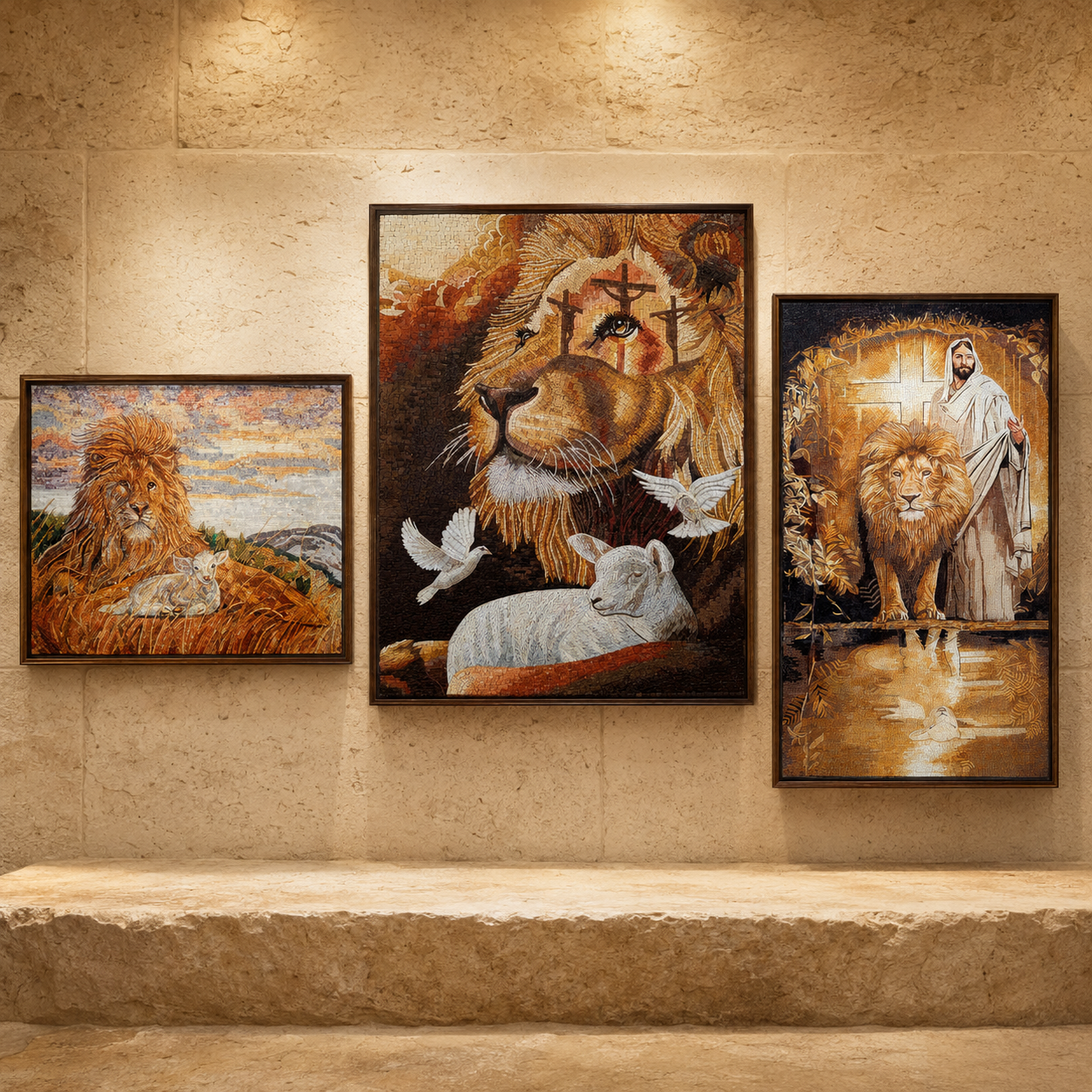
If you are drawn to Old Testament themes, consider how a specific piece might complement other biblical or symbolic mosaics you already own or are considering, such as Lion and Lamb imagery or general Christian symbols discussed elsewhere on this site. Grouping thematically related pieces on a single wall can build a more complete visual narrative of shared biblical history. These subjects also appeal to buyers who value biblical literacy and enjoy displaying art that sparks conversation or invites explanation, particularly in family homes, classrooms, or community spaces connected to a church.
Respecting Both Jewish and Christian Perspectives
Because Old Testament stories and figures are shared across Jewish and Christian tradition, mosaic art on these themes is created and presented with respect for both perspectives. This page does not present any specific artistic composition as definitive doctrine for either tradition, nor does it treat artistic interpretation as equivalent to verified historical or archaeological fact. As with all mosaic subjects in this collection, always check the specific product listing for the exact scene, dimensions, and composition of a particular design before ordering.
For a broader look at how Christian symbolism developed alongside these Old Testament themes, see our article on Christian mosaic symbols and their meanings, and for a related look at combined biblical imagery, our piece on the Lion and the Lamb mosaic meaning may also interest you. To understand the material and craftsmanship behind these pieces, read Holy Land stone mosaics. You can explore the current selection of biblical designs on the Bethlehem Mosaic homepage.
A Shared Foundation for Later Christian Imagery
Understanding Old Testament mosaic art also helps make sense of later Christian imagery, since many New Testament themes, covenant, sacrifice, guidance, deliverance, echo ideas first established in these earlier stories. Viewing an Old Testament mosaic alongside a New Testament piece, such as a Good Shepherd or Nativity scene, can highlight this continuity in a way that words alone do not always capture, making a small grouping of biblical mosaics a meaningful way to tell a fuller story across one wall.